
When Hilary Sichel, a retired pharmacist from High Wycombe, attended a routine MRI scan in late 2023, she had little reason to believe anything was amiss. The scan itself was a precaution: she and her husband had been taking a proactive approach to their health for years, undergoing private MRI scans every five years. It was a decision that, in hindsight, may have changed the course of Hilary’s life.
After her most recent scan, she received unexpected news: a brain tumour had been detected. “They told me straight after the scan, ‘Did you know you had a brain tumour?’” Hilary recalls. “I had no symptoms, never had any symptoms. I felt completely fine.”
The unexpected news marked the beginning of an equally unexpected journey that would lead her to Proton International London – home to the UK’s only private proton beam therapy service.
A Clinical Approach
Panic would be an understandable response from anyone receiving a sudden diagnosis of a brain tumour. However, Hilary’s scientific background – and years of experience as a pharmacist – helped her remain calm and methodical in the face of the diagnosis. With private medical cover through Bupa, she immediately sought a specialist opinion from Professor McEvoy, a consultant neurosurgeon in London.
“He was excellent – very reassuring,” Hilary says. “He believed the tumour was a meningioma, located deep in the centre of my brain. Surgery wasn’t an option, so we had to find another way to stop it growing.”
Initial discussions pointed towards Gamma Knife treatment, a type of targeted radiotherapy. But after further consultation with a broader team, a different recommendation came: proton beam therapy.
Proton beam therapy is a highly targeted form of radiotherapy that uses protons instead of X-rays. This allows for exceptional precision, reducing exposure to healthy surrounding tissue and minimising long-term side effects. For brain tumours in particular, its benefits are especially relevant as the treatment can avoid critical areas such as the optic nerves or the brainstem.
Hilary was referred to Dr Michael Kosmin, Consultant Clinical Oncologist at Proton International London. “He was wonderful – so calm and reassuring,” Hilary says. “He explained everything very clearly and said, ‘Yes, we can sort something out.'”
Starting Proton Beam Therapy
Proton beam therapy was approved, and Hilary began treatment, attending daily appointments throughout five and a half weeks. Despite the daily travel into central London, Hilary describes the treatment period with surprising warmth.
“It became part of our routine,” she says. “I walked from Marylebone to the hospital every day – 10,000 steps a day. And it felt good.”
As a retired couple, Hilary and her husband had enough flexibility to rearrange their schedules around her treatment. “We just cleared the diary and got on with it,” she says. “My husband was fantastic, completely supportive from the start. He just said that if that was what we had to do, then we’d do it. And we did.”
Throughout the treatment, the team at Proton International London offered comprehensive care – not only medical care, but practical assistance with the more bureaucratic aspects of the experience.
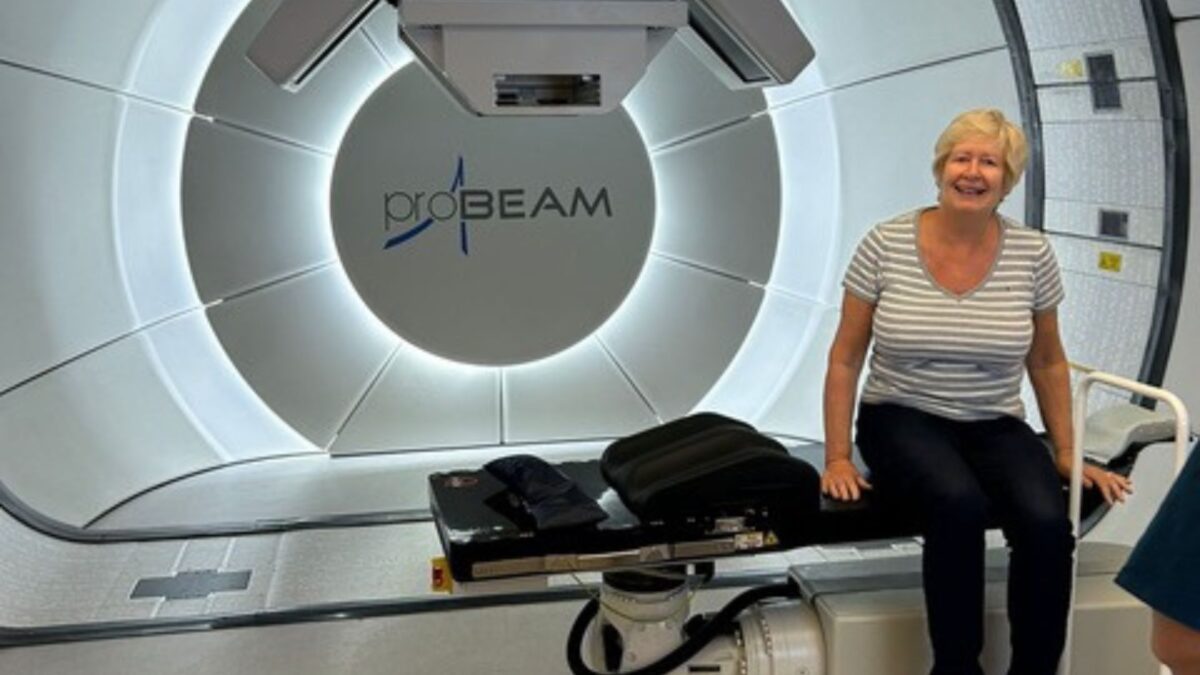
“The staff were brilliant. So friendly and helpful,” Hilary says. “And the best part was that I didn’t have to chase my insurer. Proton International London spoke to Bupa directly. That made a huge difference.”
Side Effects and Recovery
Hilary experienced no immediate side effects during her treatment. However, around four months after completion, she developed double vision as a reaction to minor swelling around the tumour caused by the therapy. Concerned, she reached out to Dr Kosmin.
“He immediately reassured me,” she says. “He arranged a scan, saw the swelling, and told me that it would go down. And he was right. It resolved on its own within a couple of weeks.”
Aside from temporary fatigue, Hilary has made a strong recovery. Regular scans since treatment have shown that the tumour remains stable. “It’s not growing, and that’s the important thing,” she says. “It’ll always be there, but it’s under control. Currently, we are continuing to do scans every six months. If things look good, that may change to yearly scans.”
Since completing treatment, Hilary and her husband have been enjoying their retirement. They have recently returned from a Mediterranean cruise and are planning their next adventure – a tour of India’s Golden Triangle. Their lives may look very different now if not for their appreciation for a proactive approach to healthcare.
“I’d seen so many people in my profession as a pharmacist who’d left everything too late, not from any fault of theirs – and then the diagnosis came too late. So I said, right, every five years we’ll have a scan. I’d rather know what’s wrong with me than not. I’m so glad I did.”
Why Proton International London?
Proton International London, located within the private patient unit of University College Hospital London (UCLH), is the only private provider of proton beam therapy in the UK. The facility brings together globally recognised experts in oncology, medical physics and radiography. It is part of the international Proton International network – known for establishing centres of excellence in the US and Europe.
Treatment at Proton International London is consultant-led, with full administrative and logistical support provided throughout. For private patients, the process begins with clinical approval and includes assistance with insurance, travel, and accommodation. The focus is on making the experience as comfortable and reassuring as possible.
For patients like Hilary, that level of support was invaluable. “I felt so privileged to use such an amazing facility,” she says. “It’s like something out of a space station. I even went to meet the team who worked out my treatment plan and thanked the engineers who keep the machine running. I just wanted to say thank you to everyone.”
Understanding Proton Beam Therapy
Proton beam therapy is not a universal treatment option. Still, for certain types of tumours – particularly those in sensitive areas such as the brain, spine or near critical organs – it can offer tremendous advantages. Because it delivers radiation in a highly controlled manner, it reduces the risk of damage to surrounding healthy tissue and organs. This, in turn, can reduce the risk of long-term side effects and offer an improved quality of life.
Proton International London offers this advanced therapy to private patients who meet clinical eligibility criteria. While treatment costs typically begin around £100,000, some private medical insurers cover all or part of the process, subject to policy terms and clinical justification.
Hilary’s message to others is simple: if proton beam therapy is recommended to you, and you have the means to access it, do not hesitate.
“It doesn’t hurt, doesn’t take long, and you’re looked after so well,” she says. “Yes, it’s a commitment, but what’s more important than your health? A new car can wait; fixing your roof can wait. Health cannot wait.”
Hilary’s experience is all that Proton International London aims to offer: expert care, personalised treatment, and reassurance every step of the way.
A Consultant’s Perspective

“Hilary’s tumour was located deep within the brain, close to critical structures, which made precision absolutely essential,” says Dr. Michael Kosmin, Consultant Clinical Oncologist at Proton International London. “Proton beam therapy allowed us to target the tumour effectively while minimising radiation to the surrounding healthy tissue. Hilary approached her treatment with a calm determination, and her proactive and positive attitude to her health played a key role in its success.”