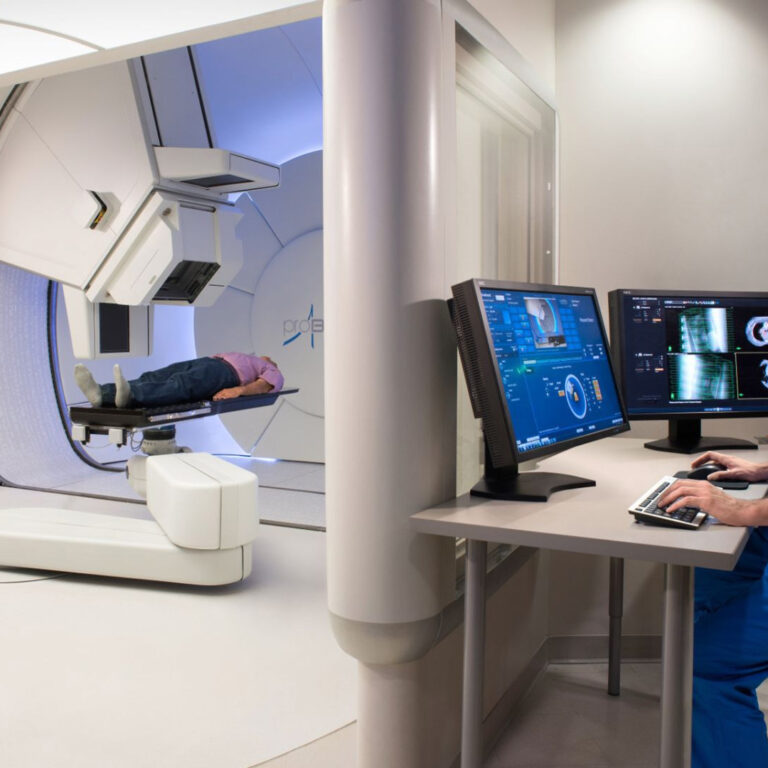
A major international Phase III clinical trial published last week in The Lancet has confirmed that proton beam therapy significantly improves overall survival while meaningfully reducing toxicity for patients with oropharyngeal head and neck cancers, marking one of the most important advances in radiation oncology in decades.
The multi-institutional study, led by researchers at The University of Texas MD Anderson Cancer Center, is the largest randomised Phase III trial to date comparing intensity-modulated proton therapy (IMPT) with conventional photon-based radiotherapy (IMRT) in this disease. It enrolled 440 patients across 21 leading cancer centres in the United States.
Clear survival benefit and reduced toxicity
The final peer-reviewed manuscript, released by The Lancet on 11 December 2025, demonstrates:
- A 10% improvement in overall survival at five years for patients treated receiving proton therapy, instead of traditional photon treatment (IMRT)
- A 42% reduction in the hazard ratio of death compared with IMRT
- Significantly fewer high-grade toxicities, including:
- Reduced feeding tube dependence
- Less dry mouth
- Improved swallowing and chewing
- Better weight maintenance, and
- Reduced immune suppression
- Improved quality of life and work productivity outcomes
Importantly, the study confirmed that proton therapy achieved equivalent disease control while substantially reducing treatment-related and post-progression deaths.
The authors conclude:
“IMPT showed non-inferiority to IMRT for progression-free survival, improvement in overall survival, similar disease control, and reduced high-grade toxicity relative to IMRT… IMPT is a new standard-of-care treatment option for patients with oropharyngeal cancer.”
A pivotal moment for radiation oncology
This Phase III trial represents the culmination of more than 15 years of clinical enrollment and research. According to the study investigators, results of this magnitude are exceptionally rare in oncology, occurring in approximately one in 8,000 therapies that are ever activated for clinical trial testing.
J.W. Snider, M.D., Chief Medical Officer at Proton International London, has acted as a primary investigator for the site at two institutions, enrolled numerous patients, and served on the trial’s clinical leadership and publications committees.
Dr. Snider recently hosted the National Association for Proton Therapy’s (NAPT) expert webinar with the study’s lead author, Professor Steven J. Frank, M.D. of MD Anderson Cancer Center, to expound upon the clinical significance of the findings.
Reflecting on the publication, Dr. Snider said the study provides the highest level of evidence clinicians have been seeking:
“This is the first randomised Phase III trial to demonstrate that reducing unnecessary radiation exposure with Proton Therapy not only improves quality of life through reductions in side effects, but Proton Therapy also meaningfully improves survival over the best IMRT at world-premiere institutions. It is a defining moment for the field and one that will dramatically influence how head and neck cancers are treated globally.”
What this means for head and neck cancer patients
Head and neck cancers often is cured with patients expected to live many decades after treatment. For these patients, short and long-term side effects, such as swallowing difficulties, chronic dry mouth, feeding tube dependence and immune suppression, can have a profound impact on suffering during therapy and daily life after treatment.
By precisely targeting tumours and sparing surrounding healthy tissue, proton therapy offers the potential to treat the cancer effectively while reducing these treatment-induced burdens. Notably, proton therapy actually improved overall survival of patients while mitigating significantly the side effects of therapy – an almost unheard of win-win therapy in oncology.
The authors of the Lancet study recommend proton therapy as a new standard-of-care for appropriate patients with oropharyngeal head and neck cancer.
Looking ahead
This landmark publication adds to a growing body of high-quality evidence supporting the clinical and economic value of proton therapy across multiple cancer types. Further analyses and follow-up publications from this research programme are expected in the coming months.
At Proton International London, we continue to support evidence-based innovation, rigorous clinical evaluation and informed patient choice, ensuring that advances in technology translate into meaningful outcomes for the people who rely on our care.