Dealing with a childhood cancer diagnosis is tough and sometimes overwhelming. When it comes to deciding on a treatment plan, naturally, your immediate concern may be how effective it is in treating the cancer.
But you may also be wondering how the treatment will affect your child’s quality of life both now and in the future. With this in mind, many parents and guardians consider proton beam therapy as an alternative to standard radiotherapy.
Proton beam therapy is an advanced form of radiation treatment that has been developed to minimise both short and long-term effects. It delivers a highly targeted radiation dose to the tumour while minimising exposure to surrounding healthy tissue. This is particularly beneficial in protecting growth and development in children and young adults.
At Proton International London, we provide private proton beam therapy for childhood cancers from our clinic in University College London Hospital (UCLH). Our proton beam therapy centre is the only private facility of its kind in the UK. Families travel to us from around the world for our care, assured that their child will receive expert treatment supported by a team that understands both their clinical and emotional journey.
To ask us a question about proton beam therapy for children and young adults, please call us on 020 4629 3598. You can also request a private second opinion, or if you are ready, start the referral process with support from your child’s doctor.
How proton beam therapy helps reduce the risk of long-term side effects
Conventional radiotherapy uses high-energy X-rays (photon radiation) to treat cancer. While it is highly effective at killing cancer cells, it has what is known as an ‘exit dose’. The beams deliver the dose to the tumour, then carry on through the body and exit the other side, meaning that the nearby organs and healthy cells are exposed to radiation. For developing children’s bodies, this can increase the risk of long-term side effects.
Proton beam therapy works differently. High-energy proton beams are precisely targeted and release most of their energy at the tumour site. Beyond this point, the proton radiation stops; there is no exit dose, which spares critical organs like the brain and spinal cord from radiation.
This is especially important for a range of childhood cancers, including spine and brain tumours, bone sarcomas including Ewing sarcoma, and soft tissue sarcomas in the trunk. Due to the precision, high doses or radiation can be delivered if needed, which can improve the outcome of the treatment.
For these reasons, proton beam therapy supports not only recovery from cancer but also protects growth and development, significantly reduces the chance of long-term side effects and can improve quality of life – for both your child and your family.
Are there side effects to treating childhood cancers with proton beam therapy?
All forms of radiation therapy carry a risk of side effects. However, because proton beam therapy minimises exposure to surrounding healthy tissue, the side effects are usually milder and less frequent.
Short-term side effects may include:
- Temporary tiredness or fatigue.
- Skin redness, dryness, or itchiness in the treatment area.
- Localised swelling, tenderness, or hair loss, depending on where the treatment is directed.
Long-term side effects:
These are less common but can occur if developing tissues are affected.
- Changes in growth or development of tissues in the treated area.
- Learning or memory difficulties if the brain is treated.
- Hormone changes if radiation affects hormone-producing glands, such as the pituitary gland
- Hearing or vision changes, depending on the treatment location.
- A very small risk of secondary cancers developing in the future.
Your expert radiation oncologists will carefully monitor potential side effects, and your care team will provide advice on alleviating any symptoms.
What to expect during your child’s treatment at Proton International London
From the start, your child’s care is managed by paediatric radiation oncologists, physicists, and radiographers, supported by play specialists and clinical nurses.
Every treatment plan is carefully designed by a consultant-led radiation oncology team.
Before treatment
- If you are travelling to London from outside of the UK, we can arrange transport and provide other practical support through our concierge service.
- After meeting for an initial consultation with your clinical and care team, your child will have detailed scans (CT or MRI) to precisely map the tumour.
- Our expert team, including paediatric radiation oncologists, physicists, and radiographers, will then design a tailored treatment plan and take you through it in detail.
- To ensure perfect accuracy during treatment, gentle immobilisation may be necessary in the form of a soft mask or body support. This will be custom-fitted before treatment starts.
- · Your child will be fully supported throughout, with each step being described in an age-appropriate and reassuring way.
During treatment
- Proton beam therapy is usually delivered on consecutive days over 4-6 weeks. Each session usually takes between approximately 30 and 60 minutes, which includes preparation and positioning, and then treatment
- The radiotherapy team will settle your child carefully on the treatment bed and place the immobilisation mask or body support if needed.
- Young children (usually under around 5 years of age) sometimes need a short general anaesthetic to stay still and relaxed during planning and treatment.
- Because the proton beam involves radiation, you and the radiotherapy team must leave the treatment room while the machine is on. However, the team uses cameras and an intercom so they can see, hear, and talk to your child throughout.
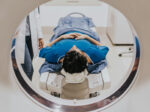
- The proton beam is delivered by a radiotherapy machine called a gantry and is similar in appearance to an MRI or CT machine. The machine moves and rotates around to deliver the proton beam, and your child remains safely in one position throughout. Whirring and clicking may be heard as the gantry moves, but the treatment is non-invasive and completely painless.
- After the session, there is no need for isolation, and most children can return home straight away.
After treatment
- The side effects of proton therapy are generally mild. Some patients experience fatigue for short periods or minor skin irritation in the treatment area. Your care team can provide advice on what to look out for and how to help ease the symptoms.
- You and your family will have regular reviews with the paediatric radiation oncologist and wider team to understand the progress of the treatment. Our team will freely offer our guidance and support, and can arrange specialist supportive care for your child and your family.
Read more about what to expect when having proton beam therapy.
Support for overseas families
If you are travelling to the UK for proton beam therapy, you are dealing with unfamiliar surroundings as well as your child’s treatment. This can be especially challenging if you are travelling with your wider family or other children.
We understand this, and so we can help to make practical arrangements, including:
- Travel booking, accommodation and transfers to and from the hospital.
- Support with insurance coordination and financial arrangements.
- Access to family-centred facilities and support services during your stay.
Read more about support for international patients.
How to refer for private proton beam therapy treatment
Proton International London is a state-of-the-art, private proton centre at University College London Hospital. We are one of only two centres in the UK that offer this treatment, and the only private proton beam therapy unit in the country that treats paediatric cancer.
If you are considering private proton beam therapy for your child, the first step is to speak with your child’s clinical oncologist. They can advise on whether proton therapy is a suitable treatment.
If proton beam therapy is recommended by your child’s doctor, we will liaise directly with them to gather all relevant clinical information to avoid unnecessary delays. Our team can advise you on paying for treatment and also help you plan your stay in London.
Our commitment to children’s care
At Proton International London, our care is led by expert consultant oncologists, and we are dedicated to advancing proton beam therapy. Our proton beam therapy centre is home to the latest technology, supported by a highly experienced team who ensure every child receives a high quality of treatment within a calm and supportive environment.
Our care goes beyond the clinical. Your dedicated care team will be there every step of the way to provide emotional support and explain things clearly. Alongside the treatment itself, we can provide practical support with accommodation and hospital transport, so you can focus on taking care of your family rather than logistics.
Talk to us about proton therapy for your child today
If you have a question about proton beam therapy, please do not hesitate to call us on 020 4629 3598. If you have consulted your child’s doctor and are ready to start the referral process, please fill out our enquiry form, and we will get back to you without delay.
Frequently asked questions – why choose proton beam therapy for paediatric cancer treatment
Is proton therapy safe for young children?
Proton beam therapy is backed by many clinical trials and considered very safe for young patients. Read more about clinical trials.
Can my child go to school during treatment?
Proton therapy is an outpatient procedure, so in most cases, your child can keep up with their studies during treatment. It is safe for them to spend time with family, friends, and classmates.
Does every child benefit from proton beam therapy?
Not all children with cancer require proton beam therapy. How suitable it is depends on the type, size, and location of the tumour. Our paediatric radiation oncologists will review your child’s case carefully to confirm whether this is the most appropriate treatment.