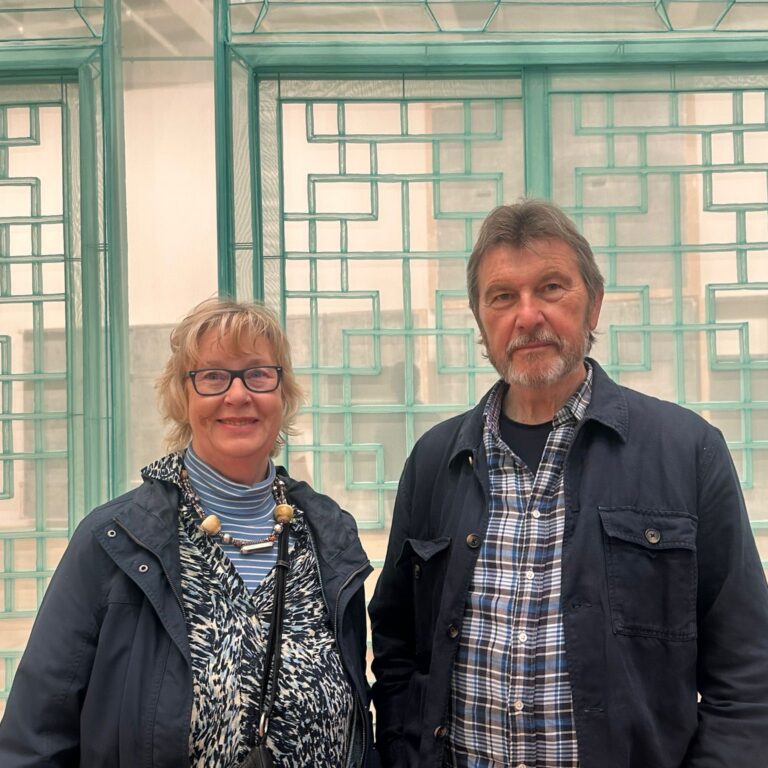
When Peter Selencky was diagnosed with prostate cancer at the age of 74, it came as a complete shock. Living a full and active life in the Peak District, just outside Bakewell in Derbyshire, he had no symptoms and no reason to suspect anything was wrong. A retired architect, Peter considered himself generally healthy, with no significant medical issues.
His diagnosis came about almost by chance. Prompted by a national prostate cancer awareness campaign, Peter decided to ask his GP for a prostate-specific antigen (PSA) test. It was not something he had ever considered before. Like many men, he had not experienced any warning signs, and routine PSA testing was not offered as standard. Still, he felt it was something he should check.
“When the result came back showing cancer, I was completely taken aback,” Peter recalls. “I just wasn’t expecting it.”
Further investigations confirmed that the cancer was localised, contained within the prostate, with no evidence that it had spread to the bones or other organs. While this was reassuring, a cancer diagnosis is never a simple matter – and it forced Peter to confront a series of complex treatment decisions.
Understanding the options
Peter was referred to his local NHS hospital in Chesterfield, where treatment options were discussed. Radiotherapy was recommended, with a plan that involved treating a wider area around the prostate to ensure the cancer was fully covered.
While Peter appreciated the care he received, he felt uncertain about the approach. “I couldn’t quite understand why so much of the surrounding area needed to be treated when the cancer was confined to the prostate,” he says. “That raised questions for me.”
He was also concerned about potential side effects. Prostate cancer treatments can affect nearby organs such as the bladder and bowel, as well as sexual function. For Peter, quality of life mattered just as much as clinical effectiveness.
Rather than rushing into a decision, he chose to pause and learn more. “I wanted to understand all the options available to me,” he says. “Once you’ve been told you have cancer, it’s easy to feel you should just accept the first plan you’re given. But I didn’t think that was the right approach for me.”
Discovering proton beam therapy
During his research, Peter came across proton beam therapy – a form of radiotherapy that uses protons rather than X-rays to target cancer. Unlike conventional radiotherapy, proton beams can be precisely controlled to deliver radiation directly to the tumour. This allows the surrounding healthy tissue to be better protected.
“At that point, I had never even heard of proton beam therapy,” Peter says. “But when I started reading about how targeted it was, it immediately made sense to me – especially because my cancer hadn’t spread.”
He also discovered that proton therapy had been used for prostate cancer in the United States for many years, often earlier in the treatment pathway. In the UK, however, access was far more limited.
Peter learned that proton beam therapy for prostate cancer was available privately at University College Hospital London (UCLH), delivered by Proton International London (PIL). After further consideration and discussion with his family, he decided to explore this option.
Making an informed choice
Choosing private treatment was not a decision Peter took lightly. As a retired professional, cost was a significant consideration.
“It wasn’t an easy decision financially,” he says. “But my family encouraged me to go with what I felt was right for my health.”
Peter arranged a consultation with Dr Jason Lester, Consultant Clinical Oncologist at Proton International London. From the outset, he felt listened to and reassured. “He understood exactly where I was coming from,” Peter says. “He explained things clearly, answered my questions, and never made me feel rushed.”
Together, they discussed Peter’s diagnosis, his priorities, and the rationale for proton beam therapy in his specific case. The treatment plan was tailored to him, reflecting Proton International London’s consultant-led approach.
Attention to detail and personalised care
One aspect of Peter’s treatment planning involved the use of a rectal spacer – a temporary gel placed between the prostate and the bowel to reduce radiation exposure to surrounding tissue further. While this technique is now widely recognised, Peter found that availability and experience varied at the time.
“I wanted to minimise side effects as much as possible,” he explains. “So I asked a lot of questions about spacers and who had experience using them.”
After careful consideration, Peter chose to have the spacer procedure carried out by an experienced clinician before beginning proton therapy. While it involved additional planning and travel, it gave him confidence that every precaution was being taken.
Treatment at Proton International London
Peter began proton beam therapy in London in 2023. His treatment involved daily sessions, Monday to Friday, over several weeks – the standard pathway at the time.
“The facilities were incredible,” he says. “It felt calm, organised, and reassuring – not at all what you might expect when you think of cancer treatment.”
Each session was carefully scheduled, and the clinical team ensured Peter knew exactly what to expect. While preparation included practical steps such as managing bladder fullness before treatment, he found the process straightforward.
“The staff were absolutely first class,” he says. “Everything ran like clockwork, and I always felt supported.”
Although travel and accommodation were logistical challenges, Peter was fortunate to stay with his son in London during treatment. Looking back, he recognises that newer treatment schedules now available may help reduce this burden for future patients.
Life after prostate cancer treatment
Today, two years on, Peter is doing well. His follow-up PSA tests have been reassuring, and he remains under ongoing review, with access to his consultant whenever questions arise.
“There’s a huge amount of reassurance in knowing you can pick up the phone and speak to someone who knows your case,” he says.
Like many men treated for prostate cancer, Peter also received a short course of hormone therapy alongside radiotherapy. “The hormone treatment was probably the hardest part,” he says. “But it was kept to the minimum necessary, and once it was over, things gradually returned to normal.”
Reflecting on his experience, Peter believes the most important message for other men is not to feel rushed or powerless after diagnosis. “Don’t assume the first option you’re offered is the only one,” he says. “Take time to understand what’s available and ask questions. No door closes behind you – the NHS was still there when I needed it.”
Above all, Peter encourages men to stay hopeful. “A prostate cancer diagnosis isn’t the end of the road,” he says. “There are effective treatments, and many men go on to live very full lives.”
Proton beam therapy today
It’s been only two years since Peter’s treatment, and in that time, proton beam therapy for prostate cancer has continued to evolve.
Traditionally, radiotherapy has been delivered in multiple smaller doses, known as fractions, spread over several weeks. This allows cancer cells to be treated while giving healthy tissue time to recover between sessions. Advances in technology, including the precision of proton beam therapy, now mean that for many men with localised non-metastatic prostate cancer, shorter treatment schedules are possible.
Most patients are suitable for moderately hypofractionated treatment, typically delivered over around four weeks. For some men with early-stage, prostate-confined disease – particularly those in low or favourable intermediate-risk categories – an ultra-hypofractionated pathway involving just five treatment sessions may be clinically appropriate.
Not all patients will be eligible for five-fraction treatment. At Proton International London, the consultant carefully assesses suitability for different treatment schedules based on individual clinical factors.
A path forward
Peter’s story highlights the importance of informed decision-making and personalised care, and how advanced technology, combined with expert clinical guidance, can support effective treatment and a higher quality of life.
“There are more options out there than people realise,” Peter says. “And knowing your options can make all the difference.”