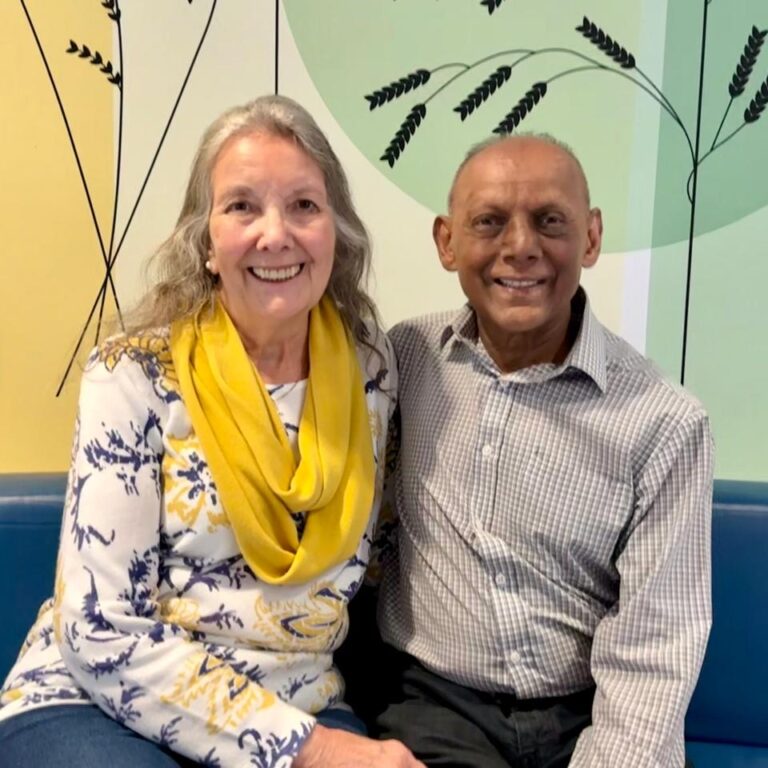
When Anthony Silva was diagnosed with squamous cell carcinoma (SCC) in his nasal cavity, he was told surgery was his only option. But the operation would have meant extensive facial removal – possibly even the loss of an eye. It was a moment that left him reeling.
“I was told I could have my face off, basically. That was all I had,” he says.
Determined to find another way, Anthony turned to his natural instincts: investigation, logic, and resilience. His decision to seek an alternative, different treatment path led him to Proton International London – the UK’s only private provider of proton beam therapy.
Limited Options
Anthony had never experienced serious health problems before. “Nothing that I had to… okay, colds and flus and that thing. But as far as any other form of problem, I have never had an operation in my life.”
The first sign of concern came from recurring nosebleeds. A visit to the GP led to further tests, then scans which showed a mass in his nasal cavity, and eventually a biopsy. “She said, I’m not going to frighten you, but we’re going to treat it as a possible cancer.”
The results came back and was confirmed as squamous cell carcinoma, a cancer affecting the thin, flat cells lining the nasal passages. Anthony adds, “Before long, this area of the bridge of the nose was swelling up to the point it was virtually straight.”
When Anthony was referred to a surgical team at a London hospital in May 2024, the proposal was stark and urgent. The appointment was on a Thursday, with the need to operate the following Tuesday – not a long time to take the drastic decision of having a great part of his face and possibly an eye removed.
Research, and a Lucky Break
Even before the meeting, Anthony knew he would refuse the surgery. With what had seemed to be his only option ruled out, Anthony began a determined search for alternatives. It was during a visit to a university in the Netherlands, where he had a longstanding professional relationship calibrating on delicate equipment, that he first heard about proton beam therapy.
“They said, you know that we’ve got a Proton Beam Therapy treatment here in the Netherlands?” That simple remark sparked a new direction in his treatment plan. “I said, can I go and have a chat? I did, and their response was Amazing!”
He spoke with a team who knew immediately what his diagnosis meant. After a short wait, he was told that they could treat, even cure, SCC in the nasal tract with proton beam therapy.
However, the relief was short-lived. Due to his age at the time – 68 – the Netherlands team ultimately declined to treat him under their public system. “They said, we have to guarantee that you can live up to 10 years after treatment… and the algorithm comes up at 1–5 years for SCC.”
With NHS access to proton beam therapy also restricted to a very small range of head and neck cancers, restricted to the same age related algorithm Anthony’s only remaining path was to seek private care in the UK.
Finding Proton International London
“When I started to research proton beam therapy in the UK, I saw we only had two places – one in Manchester and here in London UCLH.”
The Manchester centre, part of the NHS, was not an option for self-funded treatment – so Anthony reached out to Proton International London.
“I decided to contact the secretary here. And I said, can I go privately?” The response was immediate. “That’s when Dr Dawn Carnell contacted me and said, yes, it’s possible to do. And if you want to have a chat, come in – and the rest is history.”
Located within University College Hospital London (UCLH), Proton International London is the only centre offering proton beam therapy to private patients in the UK. For Anthony, the clarity and pace of support were game-changing. “It was very quick,” he says.
A Demanding Journey
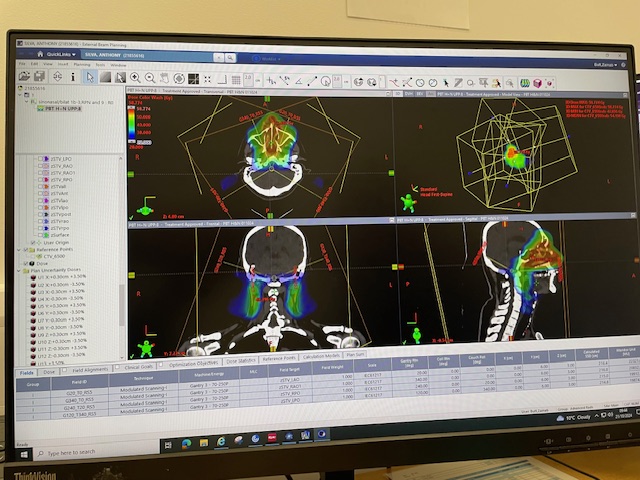
Anthony’s treatment plan involved chemotherapy and proton beam therapy, carried out in precise coordination. He recalls, “There was a day in my treatment plan that I had to go to one of the hospitals here – The London Clinic – for an infusion of the chemo, and then I had to return to UCLH for the proton beam therapy.”
The full course lasted seven weeks, with five-day treatment cycles.
“Wednesday was chemo day… going up to The London Clinic first, getting the chemo done, then getting a taxi to UCLH for proton beam therapy and then back to London Clinic to get the chemo flushed out.”
Fatigue and physical toll built up steadily; towards the end, he felt he couldn’t take it anymore. At one point, Anthony made the decision to skip the final week of treatment – but the Proton International London team stepped in.
“Dr Dawn Carnell was straight on the phone… and they insisted I finish the last week of treatment. I said, well, I’m here. I’m going to go through with it.”
To ease the pressure, the team arranged for him to stay at a nearby hotel – and Anthony completed his seven week treatment to get rid of the cancerous cells.
Why Proton Beam Therapy?
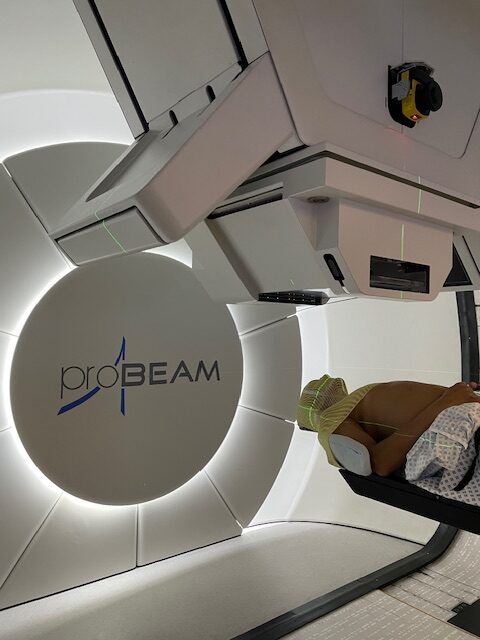
As an engineer, Anthony appreciated the mechanics behind the therapy. “Once proton beam was in my head and I understood how it worked – because I’m an engineer – I wasn’t going anywhere else,” he says. “It’s all about damage limitation, right; Especially so close to eyes, brain, etc.”
Conventional Photon Beam radiotherapy would have risked serious damage to his vision and facial function. Even with the inevitable side effects of chemo-radiotherapy, he felt Proton Beam therapy allowed him to retain far more than he might have lost.
“There are side effects, but far less than there would have been if I had gone through IMRT or any other form of conventional photon radiation treatment.”
Anthony speaks highly of the team at Proton International London. “Over and above; Especially the receptionists. They were all just so….so supportive! “Everybody in the process is positive. That’s what you want. You want positive people when you’re going through a very negative stage in your life.”
Even during his toughest moments, the team offered steady reassurance. “Some people have to have people around them, which is understandable. But I’m a sole person… I didn’t want sympathy. It’s not like me. I like to know what’s happening, and then I can manage it,” he says.
On the Other Side
Today, Anthony is back at work, running a highly specialised calibration business and looking ahead. Treatment forced him and his wife to change some plans, downsize earlier than planned and take money out of their retirement funds, but he’s not concerned.
“I’ve invested that amount of money in myself. I’m determined to get something back out of that – and that’s the longevity. You have to evaluate what your life is worth. We figured, if we need to use our retirement money, we have to do it. And the thing is now because we’ve spent that money, I want to make sure I live at least 10 more years, if nothing else, to prove that the algorithm needs to be changed. I want to prove that there are people of retirement age who still want more in their lives and are willing to make it work. I want to be strong and encourage others to fight the good fight with all their might!”
“My advice to everyone is remember that there is always someone who is worse off than you are, just look and you will see them. This phrase will help you to find your inner strength.”
A Consultant’s Perspective
“Anthony’s determination to explore every option was remarkable,” says Dr. Dawn Carnell, Consultant Clinical Oncologist at Proton International London. “When a tumour is this close to the eye and brain, every millimetre matters. Proton beam therapy allowed us to target the cancer precisely while protecting these critical structures – giving him the best chance of cure and quality of life without life altering surgery. He met the challenge with incredible resilience, and it was inspiring to support him through his treatment.”